
We are always ready to Business Needs Contact Now

Help  /  Support  /  Contact

2018 Review/2019 Preview

Volatility

Wow! 2018 went out with a huge rise in volatility as stocks swung from a small gain for the year to nearly reaching bear market territory, before rebounding yet again to end the year down 4.38% as measured by the S&P 500 index
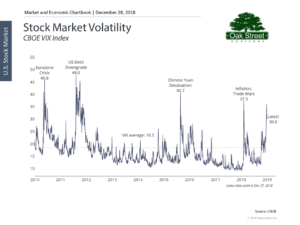
For 2019, you should expect volatility to remain high. Markets will continue to gyrate as we face increasing political uncertainty. The government shutdown will likely become an extended event, as neither side is likely to move much, and negotiating with the executive branch is like trying to eat Jell-O with chopsticks; it wiggles all over the place. While some may find these tactics a refreshing change to the way our government usually works, the markets are likely to be confused by the new normal and react with wild swings based on the latest news cycle. The unpredictability of the current administration will continue to promote volatility as markets react to a constant barrage of headlines and unconventional political tactics.


Interest Rates
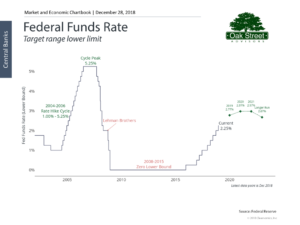
The Federal Reserve raised rates 4 times in 2018, moving the benchmark short-term rate from 1.25% to 2.25%. This resulted in a difficult year for bond investors as fixed income indices fell for the first time since 2013.
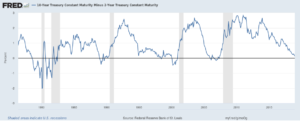
There is also concern about the yield curve. While the yield curve has not inverted yet, it is dangerously close to doing so. The chart below shows the 10-year treasury yield minus the 2-year treasury yield, going back to the 1970s. The shaded areas represent recessions. Historically, an inverted yield curve has presaged recessions and Fed economist David Andolfatto recently argued that an inverted yield curve could actually cause recessions. Regardless of whether an inverted yield curve is a leading indicator or a contributing factor to recessions, being on the cliff’s edge as we are now adds to the uncertainty surrounding markets going into 2019.


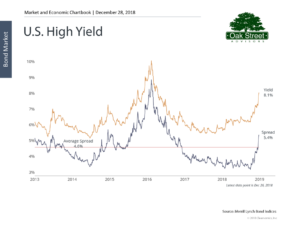
With worries about a possible recession on investors minds, credit quality spreads are finally normalizing after years of compression following the credit crunch of 2008-2009.
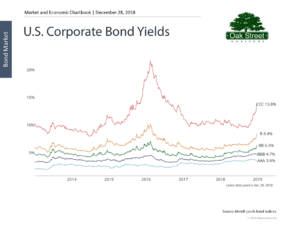
 

2019 may be the year we finally find some value in high-yield bonds after nearly a decade of tightened credit quality spreads.


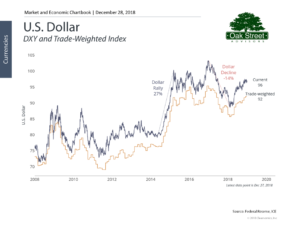
Rising interest rates also leads to a stronger dollar. This makes US produced goods more expensive for foreign buyers and can dampen the earnings of US exporters.
 

Equity Markets

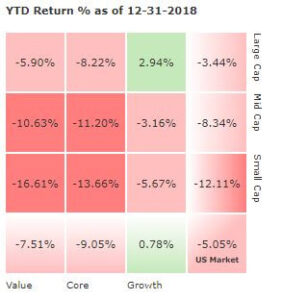
After a fast start in early 2018, the equity markets fell hard in the 4th quarter of the year. Nearly every subcategory of the market ended 2018 in the red.
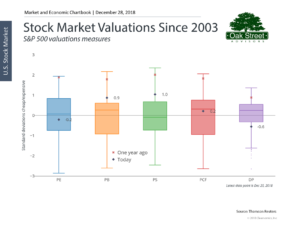
 

But compared to one year ago, equity valuations have fallen, based on many metrics.

Have equity valuations fallen enough to make stocks a compelling value? No one knows for sure, but investors should keep in mind that their default position should always be to remain fully invested. Remember, the price of the long-term gains historically inherent in the equity markets is the short-term pain caused by corrections along the way.
Investor sentiment remains muted, offering more good news for contrarian investors.
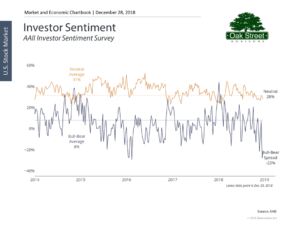
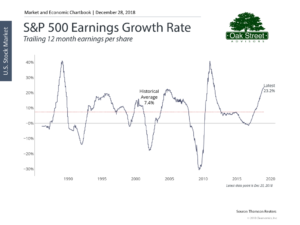
Earnings among the companies in the S&P 500 continues to grow at a torrid pace. Lower corporate tax rates have fueled stock buyback programs that allow corporate earnings per share to grow faster than the economic growth generated by normal business operations. I would expect to see a slowdown in the rate of earnings growth later in 2019, as year over year comparisons get tougher, and interest rate increases continue to take a toll on earnings growth. That does not mean we expect earnings to fall, just that the rate of growth will moderate as 2019 progresses.
2018 was also something of a dud for foreign stock investors. Developed markets produced even lower returns for US investors than did the domestic market.
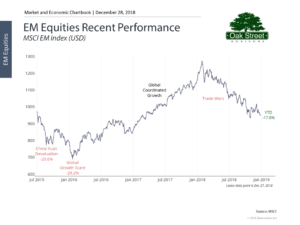
​And emerging markets were equally as disappointing.

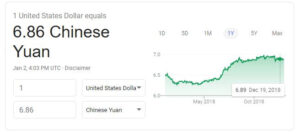
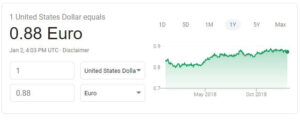
For 2019, we expect both trends to continue. Higher interest rates will generally lead to a stronger dollar and a stronger headwind for non-dollar denominated investments. In 2018, the dollar rose by about 3.5% versus the Euro and about 5% versus the Chinese Yuan. That means investors in the Eurozone needed a 3.5% gain to remain even when they convert their Euro based investments back to US dollars and investors in Chinese companies had a 5% hurdle to clear.

Conclusions

At this point we believe investors should focus on US based companies and remain fully invested. Bond durations should remain short, at least for the first half of 2019, as Fed policy is still unclear. If the yield curve does invert, we would take that as a sign to lengthen bond maturities and perhaps reduce our equity holding a bit. You should expect volatility to remain elevated and look at dips as an opportunity.

Important: This is not intended as investment advice. We share this so that our clients and prospective clients can understand some of the factors we consider as we implement their investment strategy. Any predictions of future events should be viewed with a skeptical eye.

Christina Norwood​

Christina Norwood​

Operations Manager

Born and raised in Maryland, I moved to South Carolina in 2023 and joined Oak Street Advisors’ Myrtle Beach office in 2024 as the firm’s Operations Manager.  I’ve worked in the financial service industry most of my career, including ten years for a large brokerage firm and the last two years as a Client Relations Specialist at a similarly sized RIA. 

I enjoy working hand-in-hand with our clients on all administrative and operational needs. Client satisfaction and planning efficiency are my top priorities — as I take pride in providing proactive service to every client household at Oak Street Advisors.
 
While not in the office, I enjoy quality time with my family, walking my rescue dog, Auggie, on the beach, cooking, and exploring South Carolina.

Ryan cooper

Fiduciary Financial Advisor

​I joined Oak Street Advisors’ Myrtle Beach office in 2021. I currently serve as a fiduciary financial advisor and associate financial planner. I hold the Series 65 and am working towards obtaining my CERTIFIED FINANCIAL PLANNER (TM) accreditation. 

I strive to provide clients diligent and proactive service while assisting the team with planning, investment strategies, and recommendations.

While not in the office, I enjoy running, golfing, fishing, going to the beach with my wife Natalie and our son Bennett, and watching my beloved Green Bay Packers play (I even own stock in the team!).

BRYAN TAYLOR, CFP®

Owner & President  | Fiduciary Financial Advisor

I graduated from Clemson University and began my financial planning career shortly after with a small advisory firm on the ground floor — learning the basics of financial and tax planning and running a financial advising business.

At the same time, I enrolled in the University of Georgia Terry College of Business’ Executive Program in Financial Planning and completed the coursework at nights and on weekends. Soon after, I completed my CFP® certification and joined the family business.

A year after I joined the firm, we opened our second location in Mt. Pleasant, SC where I reside with my family. Over the next 10+ years I cherished the opportunity to learn and grow the family business with my father. We worked hard to build the firm into what it is today — something we’re both proud to say we accomplished together.

Today, I serve in a Senior Advisor and Planner role, working together with our team on all financial plans and strategies. By collaborating we provide fiduciary financial and tax planning and asset management to our clients within a fee-only business model — which reflects our conviction of putting our clients’ interest above the next dollar.

When I’m away from the office, I enjoy playing golf, boating, pulling for the Clemson Tigers, and relaxing on the beach with my wife, Laura, and daughters Riley and Ramsey.

Links:
NAPFA – National Association of Personal Financial Advisors
Certified Financial Planner© Professional
LinkedIn
Fee Only Network