

We are always ready to Business Needs Contact Now

Help  /  Support  /  Contact

Coronavirus COVID-19: What it Could Mean for the Stock Market

I don’t want to add flames to the fire regarding the new coronavirus– COVID-19, however, the time to have a lifeboat drill is prior to the ship sinking. Investors should contemplate what this virus can do to the markets and world economies while they are still thinking rationally, rather than waiting until widespread panic clouds their judgement.

The COVID-19 is the same type of virus as the common cold, but it’s definitely not common. It is a strain that is new in humans, so we, as a species, have not developed antibodies to fight it, and there is no herd immunity to slow its contagion. Rather than turn to Facebook or the popular press for answers, we  recommend you visit the Center for Disease Control web site for more detailed information on what COVID-19 is and the threat it poses.

Early data shows a high fatality rate– somewhere around 2%; but keep in mind this data could well be skewed because diagnosing those infected is rudimentary at best. We are aware of nearly 100% of the fatalities but the number of cases of infection could be vastly under-reported. A coronavirus is a cold, and except in the most serious cases, likely to pass with little notice.

You’re probably aware that drug companies around the world are trying to find a vaccine. We wouldn’t hold out much hope on this front as we have been trying to find a cure for the common cold for decades with zero success.

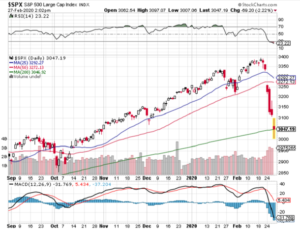
In the past week, we’ve seen the US Stock market drop by about 10% as concerns over COVID-19 have swept the globe. While markets usually do a very good job of pricing risk and opportunity, there are times when rationality tips to panic, and markets no longer function as they should. The most recent example of this was the 2008-2009 period when markets lost half of their value based on panic that the world was ending. They would eventually rebound fourfold as panic subsided and rational thought came back to the forefront.

So, is the pullback, so far, a rational repricing of risk/opportunity? Or is it the beginning of a panic? We believe it is too soon to tell.

Some companies have already announced that the COVID-19 is having an effect on their sales and earnings. Microsoft and Apple have noted problems with their supply chains. As market participants try to peer into the future, they’ve battered the travel and energy sectors, expecting consumers to avoid travel. As fear spreads this will work its way into the restaurant sector, fear of contagion may cause consumers to avoid crowded spaces where the virus could be easily transmitted. On a more basic level missed workdays and a drop in productivity could potentially hurt businesses of every type.

S&P 500 2010-Present
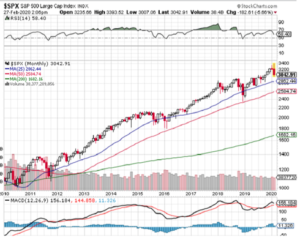
 

The stock market has had an incredible run over the past 14 months, reaching new highs at almost a monthly pace. The technical indicators we follow showed the market nearing overbought levels on a short-term basis prior to the recent drop. So, a pullback was not unexpected– with or without the COVID-19 outbreak. That doesn’t mean we expect a reversal, but it does mean we would not expect a continuation of these 2%-3% per-day drops. From a technical perspective, a pullback to around 2,600 for the S&P 500 would not be overly concerning.

If markets stabilize on a short-term basis, there are gaps in index price levels that will be filled. So, in fact, we could soon have a very good buying opportunity for long-term investors with cash to allocate to stocks.

S&P 500 Last 6 Months
What Should a Rational Investor Do?

Nothing. Rational investors know that their default position should always be to remain fully invested. It is too soon to tell if this is a normal market adjustment to new information, or the beginning of a panic. For those with reasonable investment time frames, this will be a barely noticeable blip on the long-term chart of their investment history.

​In the short term there will be times when investors doubt themselves. This is normal. We believe thinking about this problem now and preparing for an uncertain future can only help long-term investors achieve their long-term goals.

Christina Norwood​

Christina Norwood​

Operations Manager

Born and raised in Maryland, I moved to South Carolina in 2023 and joined Oak Street Advisors’ Myrtle Beach office in 2024 as the firm’s Operations Manager.  I’ve worked in the financial service industry most of my career, including ten years for a large brokerage firm and the last two years as a Client Relations Specialist at a similarly sized RIA. 

I enjoy working hand-in-hand with our clients on all administrative and operational needs. Client satisfaction and planning efficiency are my top priorities — as I take pride in providing proactive service to every client household at Oak Street Advisors.
 
While not in the office, I enjoy quality time with my family, walking my rescue dog, Auggie, on the beach, cooking, and exploring South Carolina.

Ryan cooper

Fiduciary Financial Advisor

​I joined Oak Street Advisors’ Myrtle Beach office in 2021. I currently serve as a fiduciary financial advisor and associate financial planner. I hold the Series 65 and am working towards obtaining my CERTIFIED FINANCIAL PLANNER (TM) accreditation. 

I strive to provide clients diligent and proactive service while assisting the team with planning, investment strategies, and recommendations.

While not in the office, I enjoy running, golfing, fishing, going to the beach with my wife Natalie and our son Bennett, and watching my beloved Green Bay Packers play (I even own stock in the team!).

BRYAN TAYLOR, CFP®

Owner & President  | Fiduciary Financial Advisor

I graduated from Clemson University and began my financial planning career shortly after with a small advisory firm on the ground floor — learning the basics of financial and tax planning and running a financial advising business.

At the same time, I enrolled in the University of Georgia Terry College of Business’ Executive Program in Financial Planning and completed the coursework at nights and on weekends. Soon after, I completed my CFP® certification and joined the family business.

A year after I joined the firm, we opened our second location in Mt. Pleasant, SC where I reside with my family. Over the next 10+ years I cherished the opportunity to learn and grow the family business with my father. We worked hard to build the firm into what it is today — something we’re both proud to say we accomplished together.

Today, I serve in a Senior Advisor and Planner role, working together with our team on all financial plans and strategies. By collaborating we provide fiduciary financial and tax planning and asset management to our clients within a fee-only business model — which reflects our conviction of putting our clients’ interest above the next dollar.

When I’m away from the office, I enjoy playing golf, boating, pulling for the Clemson Tigers, and relaxing on the beach with my wife, Laura, and daughters Riley and Ramsey.

Links:
NAPFA – National Association of Personal Financial Advisors
Certified Financial Planner© Professional
LinkedIn
Fee Only Network