

We are always ready to Business Needs Contact Now

Help  /  Support  /  Contact

The 5th Financial Commandment for Millennials: Implementing the Right Asset Al

Asset Allocation & Risk Tolerance
Part of Oak Street Advisors’ 10 Financial Commandments for Millennials series, understanding risk tolerance, asset allocation, and their relationship, is the foundation of modern portfolio theory. Implementing the proper asset allocation to minimize risk, while still achieving your long-term goals, is crucial to your success and peace of mind.

Asset allocation means: how much…of what asset.

What are Asset Classes?
There are 3 basic Asset Classes

  1. Securities; or Stocks
  2. Bonds/Fixed Income Securities
  3. Cash/Cash Equivalents

You could add real estate, commodities, alternatives, and other investments to this list, but for simplicity we’ll stick with these main 3 classes.

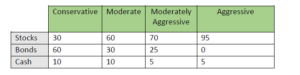
Asset allocation refers to the weight of each of these asset classes in a portfolio. Here’s a generic look at how we currently allocate the different asset classes:

For example, at Oak Street Advisors we use the following asset allocation for someone who has a Moderate Risk Tolerance:
Stocks = 60%
Bonds = 30%
Cash = 10%

This asset allocation leaves a good portion of weight to bonds and cash; which is  less risky than an Aggressive Risk Tolerance:
Stocks = 95%
Bonds = 0%
Cash = 5%

As you can see, with 95% stocks, and stocks being riskier than bonds and cash positions, the latter allocation is much riskier than the former.

The reason for using asset allocation is to manage risk inside your portfolio. The more stocks you own, the more volatility your portfolio will experience. The more stock you own, the higher your return has historically been.  We add bonds and cash to the mix to make the short-term swings in the overall portfolio value smaller, but in doing this we also reduce the potential returns provided by the portfolio as well.

We use asset allocation to allow ourselves to stay invested for the long-term gains while sleeping well at night during times when stocks temporarily fall.  Your personal asset allocation will reflect your Risk Tolerance, which can be viewed as the point where you can stay invested for the long-term gains, without making the big mistake of selling in a panic.



For some of our clients, we provide them with a short Risk Tolerance Scorecard. While brief and simplified, it gives investors a start on their comfort with investment risk. Once a risk tolerance score is determined, investors can select the appropriate asset allocation based on their individual or combined familial results. While you’re here, why don’t you determine a base-line risk tolerance by answering the following:


Grading Your Risk Tolerance:
Starting from the top down, assign the number of points from 5 to 1.

EXAMPLE:
What is your current age?
Less Than 45  = 5 Points
45 to 55 =  4 Points
56 to 65 = 3 Points
66 to 75 = 2 Points
Older than 75 = 1 Point

Each question is graded the same, 5 points for the first answer, 4 points for the second answer, 3 points for the third, 2 points for the fourth, and 1 point for the last.

Write all your points down, then add them together.

An idea of your risk tolerance is estimated from the sum of your points as follows:
1-14 = Conservative
15-21 = Moderate
22-28 = Moderately Aggressive
29-35 = Aggressive

Remembering the asset allocations from above, you can select the corresponding allocation.


​Inside those asset classes is an investment manager’s secret sauce, but any investor can achieve these general allocations via indexed ETFs.

One last point I want to present is the fact that yes, you can determine a proper asset allocation based on your personal risk tolerance; however, is that level of risk going to produce the returns necessary to meet your long-term goals? Sometimes investors must take more risk than they may be quantifiably comfortable with in order to achieve the desired outcome.

 

Christina Norwood​

Christina Norwood​

Operations Manager

Born and raised in Maryland, I moved to South Carolina in 2023 and joined Oak Street Advisors’ Myrtle Beach office in 2024 as the firm’s Operations Manager.  I’ve worked in the financial service industry most of my career, including ten years for a large brokerage firm and the last two years as a Client Relations Specialist at a similarly sized RIA. 

I enjoy working hand-in-hand with our clients on all administrative and operational needs. Client satisfaction and planning efficiency are my top priorities — as I take pride in providing proactive service to every client household at Oak Street Advisors.
 
While not in the office, I enjoy quality time with my family, walking my rescue dog, Auggie, on the beach, cooking, and exploring South Carolina.

Ryan cooper

Fiduciary Financial Advisor

​I joined Oak Street Advisors’ Myrtle Beach office in 2021. I currently serve as a fiduciary financial advisor and associate financial planner. I hold the Series 65 and am working towards obtaining my CERTIFIED FINANCIAL PLANNER (TM) accreditation. 

I strive to provide clients diligent and proactive service while assisting the team with planning, investment strategies, and recommendations.

While not in the office, I enjoy running, golfing, fishing, going to the beach with my wife Natalie and our son Bennett, and watching my beloved Green Bay Packers play (I even own stock in the team!).

BRYAN TAYLOR, CFP®

Owner & President  | Fiduciary Financial Advisor

I graduated from Clemson University and began my financial planning career shortly after with a small advisory firm on the ground floor — learning the basics of financial and tax planning and running a financial advising business.

At the same time, I enrolled in the University of Georgia Terry College of Business’ Executive Program in Financial Planning and completed the coursework at nights and on weekends. Soon after, I completed my CFP® certification and joined the family business.

A year after I joined the firm, we opened our second location in Mt. Pleasant, SC where I reside with my family. Over the next 10+ years I cherished the opportunity to learn and grow the family business with my father. We worked hard to build the firm into what it is today — something we’re both proud to say we accomplished together.

Today, I serve in a Senior Advisor and Planner role, working together with our team on all financial plans and strategies. By collaborating we provide fiduciary financial and tax planning and asset management to our clients within a fee-only business model — which reflects our conviction of putting our clients’ interest above the next dollar.

When I’m away from the office, I enjoy playing golf, boating, pulling for the Clemson Tigers, and relaxing on the beach with my wife, Laura, and daughters Riley and Ramsey.

Links:
NAPFA – National Association of Personal Financial Advisors
Certified Financial Planner© Professional
LinkedIn
Fee Only Network